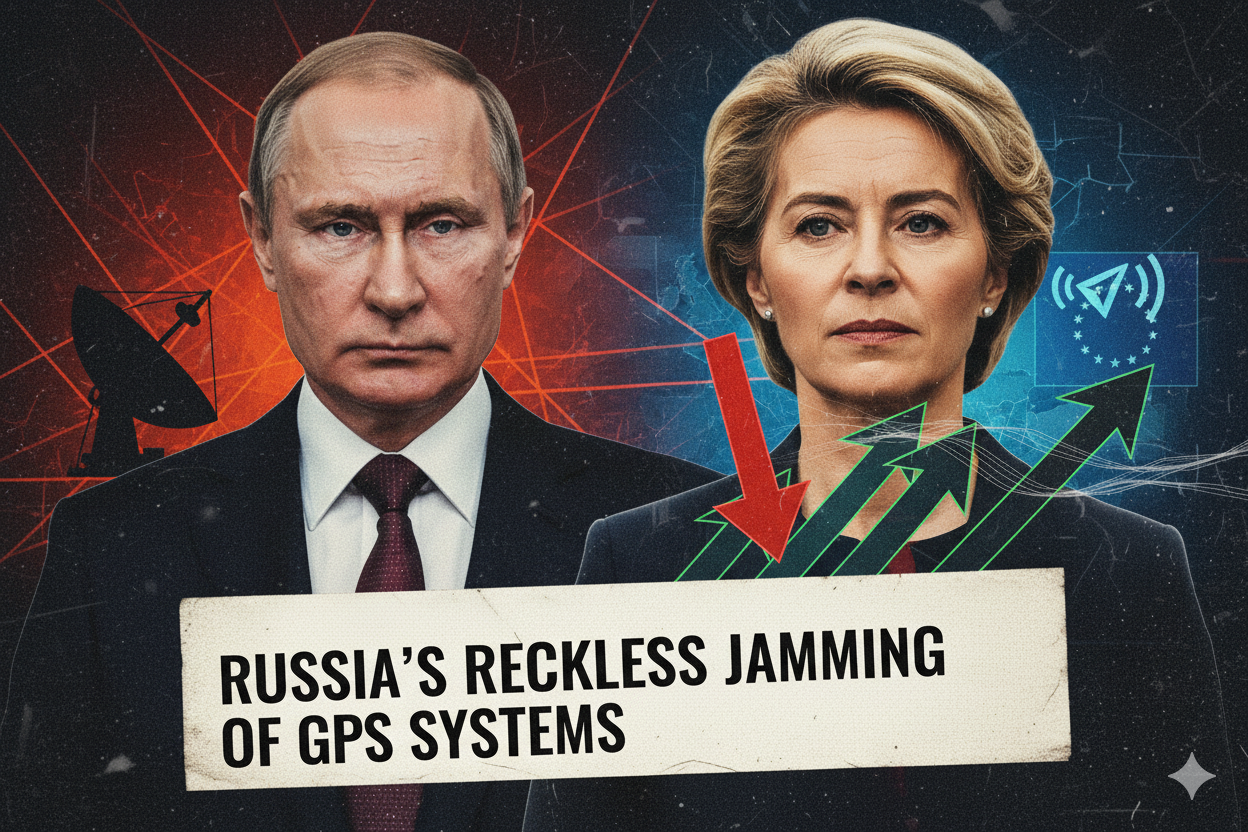
Russian GPS jamming raises fears of hybrid warfare as GPS interference hits European flights and ships
Accusations of Russian GPS jamming across Europe have surged since 2022, disrupting flights and shipping near Kaliningrad and the Baltic and Black Seas, prompting safety alarms and debate over whether this is a form of hybrid warfare.
Key takeaways
- Widespread incidents: Pilots and mariners report sudden GPS outages near Russian borders, especially in the Baltic and Black Sea regions (Euronews).
- High-profile disruption: GPS loss on the flight carrying European Commission President Ursula von der Leyen forced a diversion; Bulgaria suspects jamming (BPR, CT Public).
- Security debate: NATO and EU officials warn the interference endangers civil aviation and may constitute hybrid warfare (Air & Space Forces; Ukrainian World Congress).
Documented incidents and recent surge
Since 2022, reports of GPS outages and spoofing have risen sharply in areas close to Russian territory. Civilian aircraft have recorded sudden “GPS went dark” alerts over Eastern Europe — notably near Kaliningrad and in Bulgarian airspace — creating diversions and hazardous approaches, according to Euronews and reporting by BPR.
Maritime effects and civilian navigation
Ships in the Baltic and Black Sea regions have noted drops in navigation accuracy when GNSS signals are disrupted. Mariners report unusual position errors that raise collision and port-approach risks. The same timing signals support telecoms, power grids and financial systems, making wider civilian disruption a serious concern (Euronews).
Technical capabilities behind the interference
Analysts point to Russian electronic warfare installations capable of jamming Global Navigation Satellite System (GNSS) signals, including the U.S. GPS constellation. Known jamming sites are reported in Kaliningrad, along borders with the Baltic states, and near active combat zones in Ukraine. High-power transmitters can overwhelm the weak satellite signals, affecting aircraft, ships and ground systems across wide areas (Air & Space Forces).
Patterns, victims and civilian risk
Officials note a spike beginning August 2024. Airline crews have reported sudden GPS losses during approaches near eastern NATO borders, forcing reversion to older navigation methods or diversions. In crowded airspace, at night, or in poor weather, outages can escalate into emergencies. Merchant ships and ferries have logged position anomalies that increase collision risk in tight channels (Air & Space Forces).
Motives: hybrid warfare or spillover from combat?
European leaders have described the jamming as a possible element of hybrid warfare — coercive actions that fall below the threshold of open conflict. By disrupting navigation, a state can impose costs and erode confidence without kinetic force. NATO and EU officials say such behavior breaches international norms (Air & Space Forces).
Other experts caution that some interference may be collateral: jamming intended to blind drones or mask military movement can bleed into neighboring civilian airspace and sea lanes. The result is the same — civilian harm — even if the primary target is military (Air & Space Forces).
Attribution challenges and political stakes
Attributing jamming is technically complex and politically charged. Signals are transient; masking and false flags are possible; independent verification takes time. Still, observers such as Keir Giles of Chatham House note that Russia possesses both the capability and a demonstrated willingness to employ aggressive electronic warfare in ways that can disregard civilian safety (BPR).
“Russia has shown both the tools and the appetite to employ large-scale electronic warfare in ways that can be reckless toward civilians.” — Keir Giles, Chatham House
Safety and political fallout
Civil aviation authorities and NATO officials have raised alarms about the growing danger to civil flights. Governments have publicly condemned the interference and called for accountability, with pressure mounting for diplomatic, legal and technological responses. Politically, the incidents are viewed as part of a broader pattern of coercion, including cyberattacks and disinformation, increasing calls for deterrence and civilian protections (Euronews).
European countermeasures under discussion
Officials and experts advocate a multi-layered response:
- Diversify navigation: Invest in backup systems and alternatives that do not rely solely on GPS (Euronews).
- Improve reporting and attribution: Better incident logging and international coordination to build cases for diplomatic or legal action (Euronews).
- Harden infrastructure: Encourage anti-jam receivers, fallback navigation, and safety advisories for airlines and shipping (Air & Space Forces).
Expert voices
Keir Giles (Chatham House) warns of reckless use of electronic warfare; Tapio Pyysalo of the Hybrid CoE (Finland) notes much interference looks collateral but insists civilian harm is real. These perspectives underscore both intent and unintended consequences (BPR, Air & Space Forces).
Implications for Redding, California
Although incidents are concentrated in Europe, the lessons are global. Local implications include:
- Local aviation and emergency services: Airports, flight schools and medevac operators should review contingency procedures and training for GPS outages; emergency services should assess backup timing and positioning systems.
- Commercial trucking and logistics: Freight operators should consider inertial or alternative navigation and redundant timing to maintain routing and fleet management during GNSS disruptions.
- Critical infrastructure: Utilities and telecoms that rely on GPS timing should evaluate fallback time sources to protect continuity.
- Economic and security posture: The episodes highlight the need for resilient infrastructure and stronger national defense measures against hybrid threats.
- Community readiness: First responders and hospitals should test fallbacks; businesses can prepare simple contingency plans (paper maps, manual timing checks).
Sources and reporting
This article draws on reporting and analysis from: Euronews; Air & Space Forces Magazine; WGBH/BPR; CT Public Radio; and the Ukrainian World Congress.
Preserved facts and source URLs appear above for verification and follow-up reporting.