
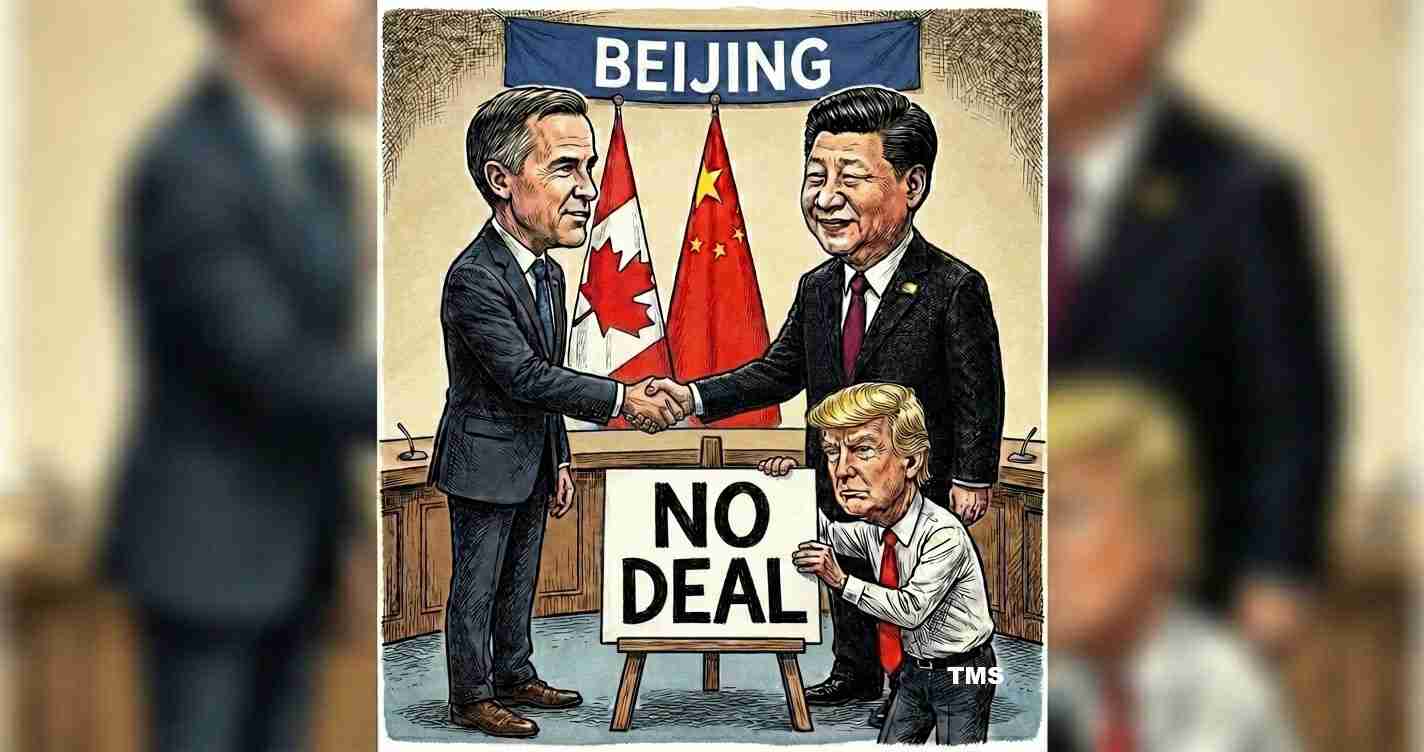
Trump Threatens 100% Tariffs on Canada Over Possible China Trade Deal, Calls Prime Minister “Governor Carney”
President Donald Trump warned Jan. 24, 2026 that he would impose a 100% tariff on all Canadian imports if Canada strikes a trade deal with China, accusing Prime Minister Mark Carney of turning Canada into a “drop off port.”
Key takeaways
- Tariff threat: Trump said on Truth Social he would hit Canada with a 100% tariff if Ottawa makes a deal that turns the country into a “drop off port” for Chinese goods — reported by ABC News.
- Personal jab: He called Prime Minister Mark Carney “Governor Carney,” repeating rhetoric that critics view as provocative — coverage by NBC Montana / AP.
- Deal at issue: Reporting says Ottawa and Beijing agreed to lower Canadian EV tariffs for reduced Chinese tariffs on some Canadian farm goods — details in ABC News.
- Local impact: A tariff war could ripple to places like Redding, Calif., affecting prices, supply chains and local industries — see video coverage referenced here.
Trump’s post and specific charges
In a Truth Social post, the president wrote that if “Governor Carney” tries to use Canada as a “Drop Off Port” for China to send goods into the United States, “he is sorely mistaken.” Trump warned:
“China will eat Canada alive, completely devour it, including the destruction of their businesses, social fabric, and general way of life.”
He added that “If Canada makes a deal with China, it will immediately be hit with a 100% tariff against all Canadian goods and products coming into the U.S.A.” (Source: ABC News.)
Context: the Canada-China agreement at issue
Reporting describes a narrow agreement in which Ottawa reduced tariffs on Chinese electric vehicles while China agreed to lower tariffs on certain Canadian agricultural exports. Trump framed the arrangement as a potential backdoor for Chinese products to reach U.S. markets through Canadian ports and cited national security and protection of U.S. manufacturing as his rationale, without detailing a legal path for a blanket 100% tariff. (See ABC News.)
Canadian pushback and official responses
Canadian officials pushed back quickly. Dominic LeBlanc, the minister responsible for Canada–U.S. trade ties, said there is “no pursuit of a free trade agreement with China.”strong
Prime Minister Mark Carney, speaking at Davos, stressed Canada’s independence and warned about the global “rupture” from great-power rivalry. Canadian leaders emphasized the “remarkable partnership” with the United States while rejecting the premise that Ottawa seeks a broad free-trade pact with Beijing. (Coverage: ABC News; NBC Montana / AP.)
History of tensions and related moves
This episode fits a pattern of public friction: Trump has a history of calling Canadian leaders “governor,” proposing controversial ideas such as acquisition of Greenland, and altering maps to depict Canada in provocative ways. He also revoked an invitation for Carney to participate in his proposed “Board of Peace.” (Reporting: NBC Montana / AP.)
Trade stakes and numbers
Canada is the United States’ second-largest trading partner. Media reporting highlights that roughly three-quarters of Canada’s exports go to the U.S., underscoring the close economic link and how disruptive a sudden 100% tariff would be for businesses and supply chains on both sides of the border. (See related video coverage.)
Legal and policy questions
A unilateral, economy-wide 100% tariff would raise immediate legal, trade and diplomatic questions. U.S. trade law grants the president authorities to impose tariffs for national security or unfair trade practices, but broad measures of this size against a major partner would be unprecedented and likely face legal challenges and retaliation. The president’s post did not outline a legal path or timeline. (Context: ABC News.)
What critics and allies might say
Trade experts warn sweeping tariffs raise consumer prices, disrupt supply chains and invite retaliation. For conservative audiences prioritizing secure borders and U.S. industry, the rhetoric may resonate; analysts note that targeted sanctions, export controls, and allied coordination are often more sustainable tools for addressing national-security concerns tied to China. (Reporting and analysis cited in ABC News.)
Implications for Redding, California
Economic impact
Redding residents could feel a ripple from a tariff clash: higher prices for goods, disruptions to local manufacturers and retailers, and challenges for Northern California exporters. Companies that import parts or depend on cross-border supply links may face contract and shipping disruptions. (See video context and reporting.)
Political consequences
Conservative voters in Redding may frame the move as defending American jobs and industry, while others will worry about higher consumer prices and damaged relations with a close ally. Local leaders may be pressed to weigh in as constituents evaluate trade and national-security tradeoffs. (Source: NBC Montana / AP.)
Social effects
Indirect social impacts could hit Redding workers in trucking, warehousing, manufacturing and agriculture if supply chains slow or reroute. Port delays and higher transport costs would affect businesses serving the local market. (Trade context and coverage: ABC News.)
Cultural relevance
A tariff fight with Canada resonates in Northern California, where sovereignty and self-reliance matter to many. Conservative audiences in Redding might view a hard line as aligned with defense priorities, while long-standing cross-border ties could make any rupture feel unusually close. (Coverage: NBC Montana / AP.)
Practical applications
Residents and local businesses should watch for near-term effects in grocery prices, fuel and shipping, and availability of certain goods. Businesses that import or export should review contracts, consider contingency shipping plans and consult trade advisers about potential disruption scenarios. (Practical steps referenced in ABC News.)
Reporting notes and sources
This article draws on reporting from ABC News (Jan. 24–25, 2026), coverage from NBC Montana / AP, and public video excerpts of the president’s statements available at video 1 and video 2.
Note: Legal, diplomatic and economic fallout from the president’s threat could evolve quickly. Officials in Washington and Ottawa say they are monitoring developments as trade officials and ministers clarify whether broader agreements or negotiations with China are planned. (Sources above.)



