
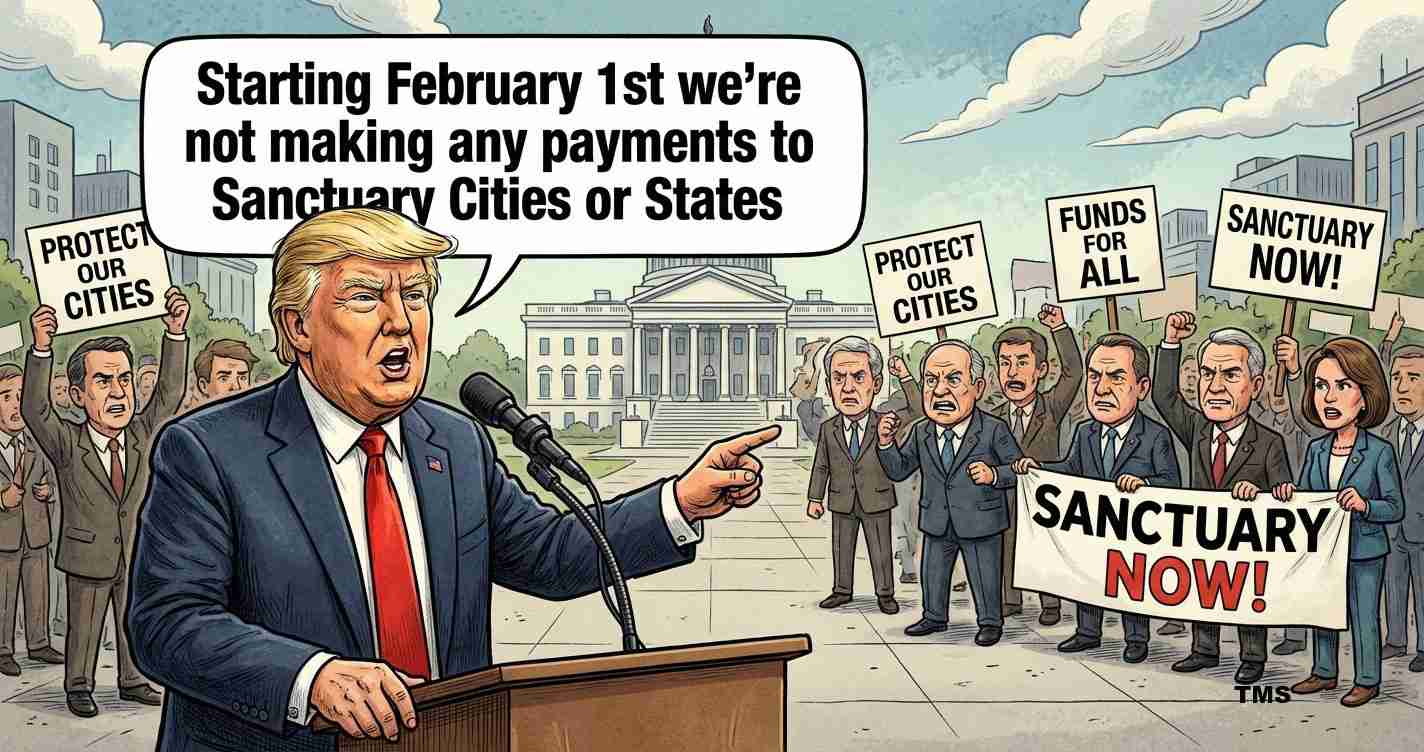
Trump says federal payments to “sanctuary” cities, states will stop Feb. 1; Minnesota fraud allegations highlighted
President Donald Trump announced his administration will stop federal payments to sanctuary cities and states starting Feb. 1, accusing those jurisdictions of protecting criminals and citing alleged fraud in Minnesota’s child care programs and suspended payments tied to suspected scammers.
- Funding halt announced for sanctuary jurisdictions starting Feb. 1 — Trump said the payment stop targets jurisdictions he says “protect criminals.” (WTOV9)
- Minnesota singled out for alleged child-care fraud — The president said payments tied to suspected scammers in Minnesota have been suspended. (KATV)
- HHS previously moved to withhold funds to several states over fraud concerns — California, Colorado, Illinois, Minnesota and New York were flagged. (Fox News)
- Court interventions are likely — federal judges have previously blocked similar efforts and a temporary order recently preserved funding while legal challenges proceed. (Fox News (US))
Main content
Key information
Announcement and timing: President Trump told the Detroit Economic Club his administration will stop federal payments to jurisdictions it designates as sanctuary beginning Feb. 1. (KRCRTV)
Minnesota fraud allegations: The president linked the policy to alleged fraud in child care programs and said payments tied to suspected scammers in Minnesota have been suspended. (KATV)
HHS actions: The Department of Health and Human Services previously moved to withhold funds tied to child care and family assistance in five states amid concerns some funds were not verifiably used lawfully. (Fox News)
What Trump said and how he framed the policy
“Starting Feb. 1, we’re not making any payments to sanctuary cities or states having sanctuary cities because they do everything possible to protect criminals at the expense of American citizens,” Trump said, adding that such policies “breed fraud and crime and all the other problems that come.” (KRCRTV; WTOV9)
He specifically attacked Minnesota and Gov. Tim Walz, saying the state was “getting destroyed” by fraud and that payments tied to suspected scammers there were suspended. (KATV; Fox News)
Context: Minnesota fraud allegations and HHS actions
HHS identified concerns with program integrity across several federal assistance programs and sought to withhold funds related to child care and family assistance in California, Colorado, Illinois, Minnesota and New York, saying some expenditures could not be confirmed as lawful or used for intended purposes. (Fox News)
Legal response: Federal courts have intervened in prior efforts to strip funding. On Jan. 9, U.S. District Judge Arun Subramanian temporarily blocked the funding halt, preserving funds while legal arguments proceed; the temporary order did not decide the merits of the government’s authority. (Fox News (US))
Broader administration actions on sanctuary jurisdictions
This announcement follows prior administration steps: the Department of Homeland Security released a list of more than 500 areas it labeled “non‑compliant” with federal immigration law, and the Justice Department has sued several cities and states over sanctuary policies — including Los Angeles, Chicago, Newark, Hoboken, Jersey City, Paterson, Rochester and states such as Illinois, Colorado and New York. (KRCRTV; ABC7)
Administration rationale vs. critics: Officials say withholding federal funds is a lever to enforce compliance with federal law and protect public safety; critics argue it may exceed executive authority and harm vulnerable families dependent on federal programs.
What remains unclear
Officials have not published a comprehensive list of which payments will be stopped, the total funding at stake, or the specific legal authority the administration will invoke. Past attempts were partially blocked by courts, and legal experts expect additional court fights. (ABC7; Fox News (US))
Sanctuary cities immigration policy: enforcement and politics
Core debate: Supporters of sanctuary policies say limiting local cooperation with federal immigration enforcement builds trust with immigrant communities and improves safety; opponents — including the administration — say such policies let criminals go free and argue for using federal funding as leverage. (KRCRTV)
Implications for Redding, California
Economic impact
- California was among the states where HHS moved to withhold funds tied to child care and family assistance — sustained federal cuts could affect counties and cities in Northern California, including Shasta County and Redding. (Fox News)
- Potential local effects include fewer subsidies, delayed payments to providers, or pressure on county budgets to cover shortfalls.
Political consequences
- Redding’s conservative-leaning electorate may welcome stronger immigration enforcement and fiscal accountability messaging.
- Escalation between state and federal leaders could intensify local political debates and campaigns.
Social effects
- Families relying on child care assistance are vulnerable to disruptions; temporary freezes or delays can create instability for working parents and local providers.
- Debates over law enforcement cooperation may affect immigrant communities’ trust in local police and reporting of crime.
Cultural relevance
Local values — public safety, fiscal responsibility and family support — will shape Redding’s response. Conservative residents may press for accountability while community organizations may advocate to protect vulnerable residents and service continuity.
Practical applications for residents and local leaders
- Parents and providers: Monitor notices from local agencies and the California Department of Social Services; providers should maintain complete records to reduce risk of payment delays. (Fox News)
- County and city officials: Review budgets and contingency plans; consider temporary local funding or seeking state relief if aid is reduced.
- Lawmakers and voters: Demand clarity on which programs are at risk and the conditions for restoring withheld funds.
Sources and further reading
- KRCRTV: Fraud and crime — Trump to halt payments to sanctuary cities beginning Feb. 1
- WTOV9: Fraud and crime — Trump to halt payments to sanctuary cities beginning Feb. 1
- KATV: Fraud and crime — Trump to halt payments to sanctuary cities beginning Feb. 1
- Fox News: Trump to cut federal payments to sanctuary cities starting Feb. 1
- Fox News (US): Trump to cut federal payments to sanctuary cities starting Feb. 1 — legal obstacles
- ABC7: Trump threatens to halt federal money next month to sanctuary cities, states



