
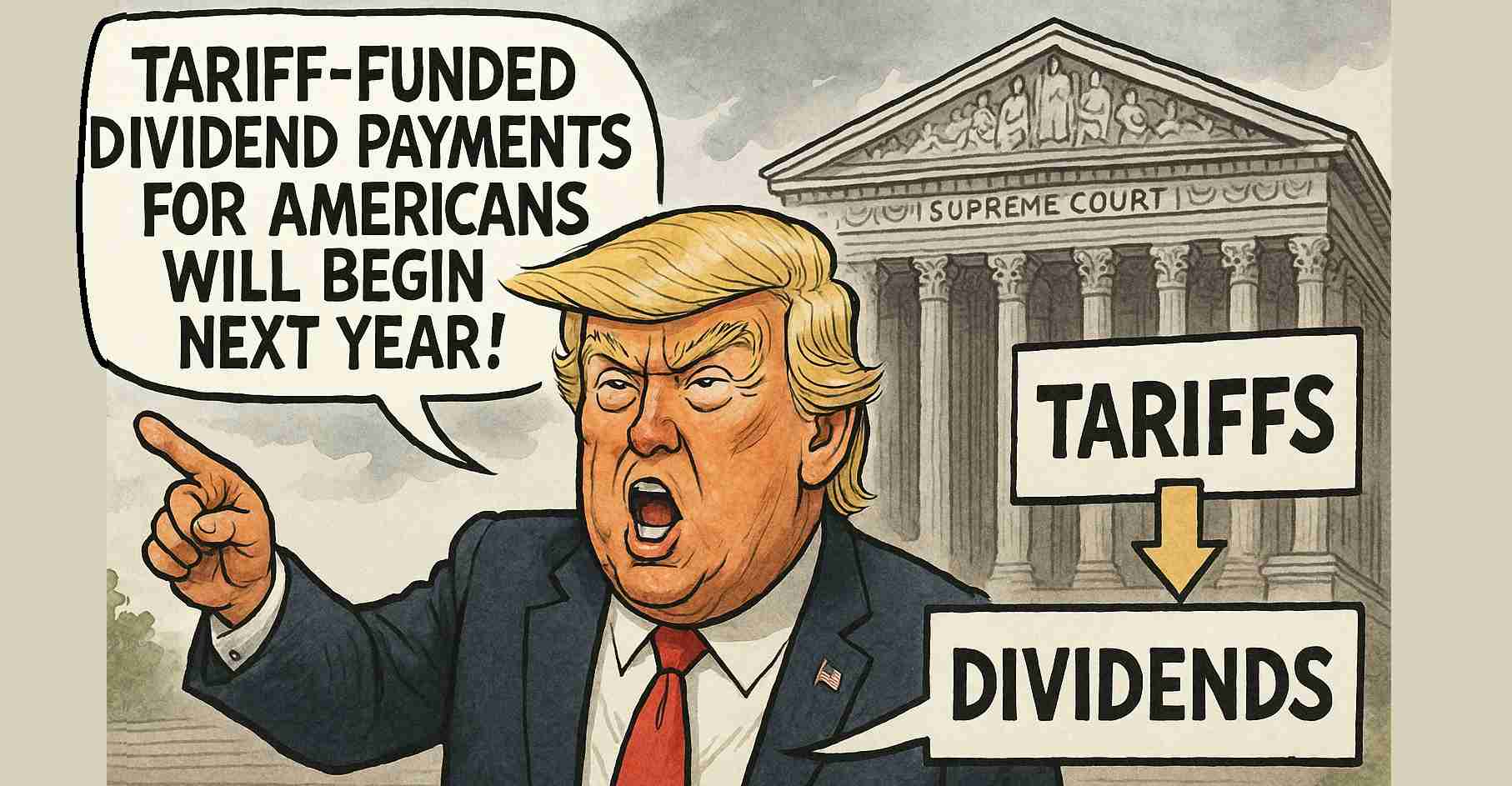
Trump says “tariff-funded dividend” checks could begin in 2026, but experts and courts raise doubts
Former President Donald Trump proposed ‘tariff-funded dividend payments’ to begin as early as 2026, promising direct checks from increased tariff revenue — a plan economists, legal scholars and courts say faces serious feasibility, fiscal and constitutional hurdles.
Key takeaways
- Tariff-funded checks: Trump says Americans could receive “hundreds of millions” in dividend payments funded by tariff collections by mid-2026.
- Legal and constitutional doubt: Experts warn Congress controls spending and the Supreme Court is reviewing presidential tariff authority, complicating unilateral action.
- Economic limits: Tariff revenue is volatile and smaller than often portrayed; tariffs act like a tax on U.S. consumers and businesses.
- Local implications: Redding residents could face higher prices and disrupted supply chains even if some receive dividend checks.
How the plan would work, and the immediate questions
The proposal — often called “Trump tariff dividends” by supporters and critics — is pitched simply: increase tariffs on imports, collect additional revenue, then distribute some of that revenue back to Americans as direct dividend checks. Trump framed it as making foreign exporters “pay” and sharing gains with U.S. workers and families.
In practice the mechanics are complex. Tariffs are collected by federal agencies and flow into the U.S. Treasury as general revenue. Under the Constitution, Congress controls federal spending, meaning any sustained, large-scale payment program would likely require congressional authorization and appropriation (Brookings Institution; Peterson Institute).
Legal limits and the Supreme Court review
The idea arrives while the U.S. Supreme Court is reviewing cases about the scope of presidential tariff authority. If the Court narrows that authority, it could restrict a president’s ability to impose broad new tariffs without Congress and complicate any plan that relies on tariffs to fund payments (Reuters; The New York Times).
“Redirecting tariff revenue into individual dividend checks without specific law passed by Congress would be legally risky,” legal scholars say. The president can propose, but Congress would likely need to pass enabling legislation. (Brookings; Congressional Budget Office)
Economic reality: tariff revenue is limited and costs land on Americans
Economists emphasize two central points: tariffs act like a tax on imports, and tariff receipts are much smaller than suggested by proponents. Higher tariffs typically raise prices for U.S. businesses and consumers, and those higher costs can offset any dividend checks paid out.
For context, U.S. tariff collections were roughly $79 billion in 2023 — a meaningful number but small relative to total federal spending and insufficient to fund large, sustained payments widely, according to the Congressional Budget Office and the Peterson Institute. Revenue is also volatile: it falls when imports drop or when trade partners retaliate.
“A tariff is a tax,” trade economists note. Collecting a few billion more in tariffs won’t erase the higher costs imported goods place on households. (Peterson Institute; Brookings)
Political reaction: mixed support, bipartisan skepticism
Some supporters say the idea is politically compelling: it promises to make foreign producers bear costs and return direct benefits to households — messaging that can resonate in manufacturing and rural areas. Conservative commentators have framed it as a populist approach to trade reform.
But lawmakers across the spectrum expressed concerns. Some Republicans warned that reliance on executive action would be legally vulnerable or fiscally unsound; Democrats argued the plan is economically flawed and risks retaliation. Even within conservative circles, questions remain about program structure and effectiveness. (Associated Press; Wall Street Journal)
Trade partners and business groups push back
Foreign governments and many U.S. business groups warn that higher tariffs invite retaliation, raise costs, and disrupt supply chains. Import-dependent companies — including those supplying parts to U.S. factories — could face higher input costs that harm competitiveness and jobs. Economists caution that once higher consumer prices are counted, many households may be worse off even if dividends are paid. (Bloomberg; Reuters)
Implementation challenges
Designing a reliable dividend program raises many questions: who qualifies, whether payments are per-person or household-based, how payments are calculated, and how often they are made. Tariff revenue volatility makes multi-year commitments difficult without a reserve or fallback funding mechanism — which would likely require congressional budgeting and oversight. (Congressional Budget Office; Brookings)
Why the plan matters now: the 2024 campaign and U.S. tariff policy debate
The announcement re-centers tariffs as a campaign issue. It signals a potential return to more aggressive trade barriers if Trump wins and ties trade policy directly to household pocketbooks. The court rulings on presidential tariff authority will shape how much a future president can act without Congress.
Implications for Redding, California
Economic impact
Local consumers in Redding could see higher retail prices on imported electronics, appliances, clothing and parts. Local businesses that rely on imported inputs may face increased costs that squeeze margins. Agricultural exporters risk retaliation that could reduce overseas demand and depress prices for crops and livestock.
Political consequences
The dividend pitch may appeal to conservative voters in Redding who favor protectionist policies. City and county officials may need to respond to constituents expecting relief or protection for local jobs, which could influence local endorsements and campaign dynamics.
Social and practical effects
For lower- and middle-income households the net effect is uncertain: a one-time payment might help temporarily, but sustained higher prices could erode purchasing power. Local tax receipts tied to sales and business activity could be affected if economic activity slows.
Cultural relevance
The messaging — making foreign producers pay and delivering direct payouts — appeals to residents who favor protection for U.S. industry and are skeptical of distant policymakers. The populist framing may resonate even where experts warn of economic downsides.
Practical steps for Redding residents
- Watch prices: Monitor how tariffs affect the cost of commonly purchased imported goods.
- Engage representatives: Contact congressional offices to ask how tariff proposals could affect local industries and whether they would support enabling legislation for dividend payments.
- Prepare for volatility: Businesses should plan for possible shifts in tariffs and the risk of higher input costs or trade retaliation.
Sources and further reading
The New York Times
The Wall Street Journal
Bloomberg
The Associated Press
Peterson Institute for International Economics
Brookings Institution
Congressional Budget Office
Reporting based on coverage and analysis by the above outlets and policy institutions.



