
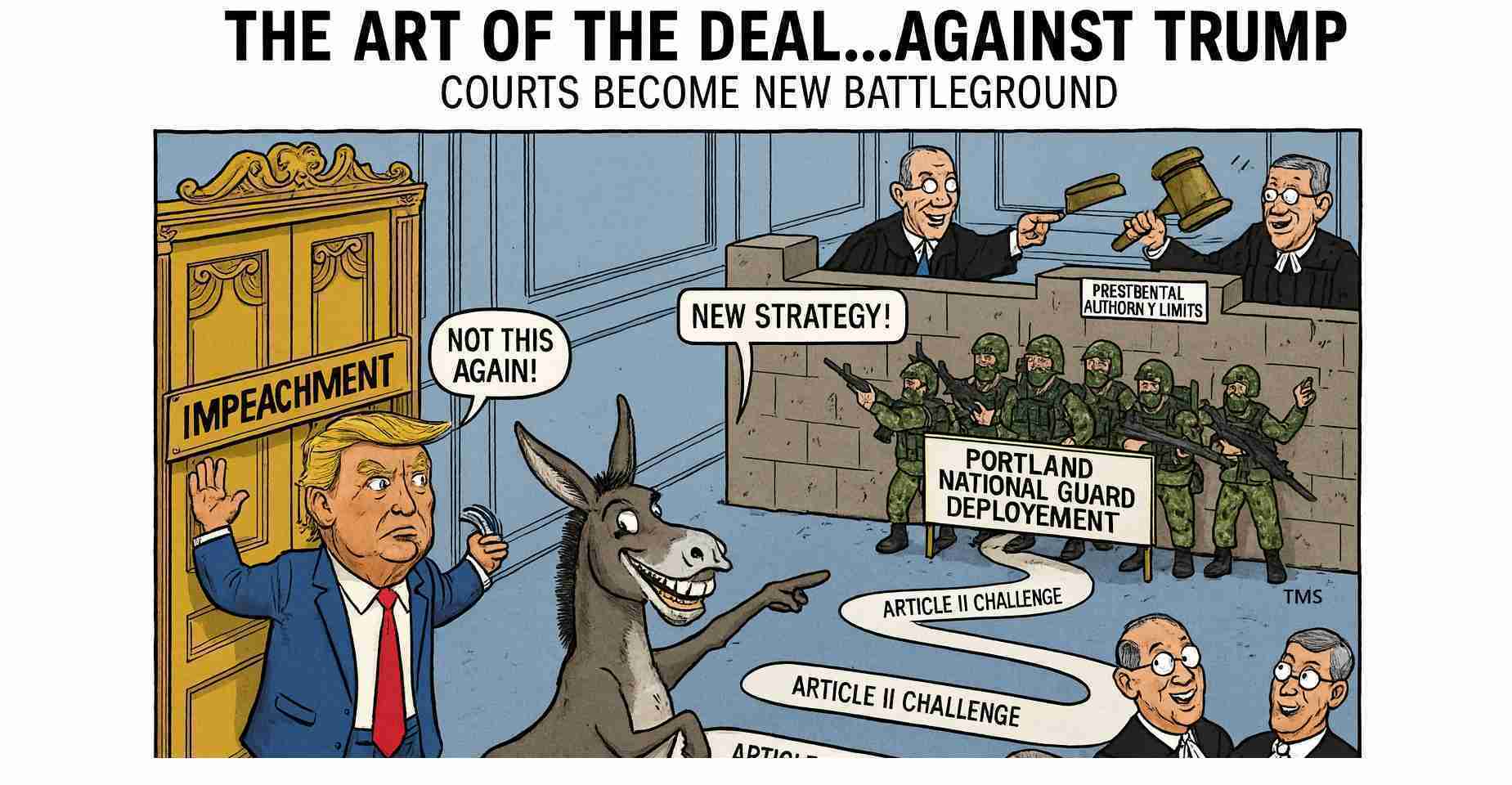
Dems Use Article II Constitutional Challenges to Curb Trump; Portland National Guard Deployment Becomes Court Battleground
Democrats increasingly rely on Article II litigation to check President Trump’s executive actions, shifting fights from impeachment to federal courts—most notably in disputes over the Portland National Guard deployment, where judges are shaping the limits of presidential power.
Key takeaways
- Litigation over Article II has become a primary tool to constrain executive actions, often producing faster, case-specific relief than impeachment.
- Portland’s National Guard deployment is a leading test of whether federal forces can be used inside states without violating statutory or constitutional limits.
- Federal courts have issued mixed rulings — temporary restraining orders and injunctions in some cases, deference in others — producing an unsettled legal landscape.
- Ongoing doctrinal shifts at the Supreme Court could either expand executive authority or preserve statutory checks enforced by lower courts.
Article II challenges replace impeachment as main legal tool
In recent months, Democratic lawmakers, state attorneys general, civil-rights groups and civic coalitions have increasingly turned to the courts to block or slow federal actions they argue exceed presidential authority. These claims are framed as Article II constitutional challenges — legal actions asserting that an order or action violates constitutional limits on executive power.
Plaintiffs typically ask judges to issue temporary restraining orders, preliminary injunctions, or rulings that a policy is unlawful under federal statute. Observers say litigation can be faster and more surgical than impeachment, which is political, time-consuming and uncertain.
Legal trackers document a growing docket: more than a dozen suits by spring 2025 tied to alleged executive overreach and dozens of restraining orders. See the litigation tracker at Just Security for a running list and analysis.
Why Portland matters: National Guard deployment as a test case
The Portland National Guard deployment has become a focal legal test of how far the president can move federal forces into state or local spaces. Federal officials cited threats to federal buildings when sending National Guard and other federal personnel. Local leaders protested, calling the response heavy-handed and intrusive on state responsibilities.
Courts were soon asked to decide whether the president’s actions complied with the Constitution and statutory limits governing domestic military use.
Reporting and analysis on these legal stakes are collected at The Regulatory Review.
Courts pressed to weigh statutory rules and emergency claims
Lawsuits connected to Portland and similar actions ask whether invocations of emergency powers, or claims to protect federal property, fit within statutes such as the Insurrection Act and related federal rules. Plaintiffs argue statutes set clear limits the president must follow; simply asserting a need to protect property does not erase those constraints.
Federal judges have reacted unevenly: some issued restraining orders pausing enforcement of specific directives, while others deferred and allowed federal actions to proceed. This patchwork means outcomes often turn on case-specific facts and statutory wording. Trackers and case notices catalog these developments, including examples compiled at Callabor Law.
Supreme Court doctrine and the push-pull over presidential power
Recent Supreme Court decisions have been read by many scholars as trending toward a broader view of Article II, emphasizing substantial executive authority to direct federal officers and control national-security and foreign-affairs matters. Critics warn that such readings could reduce meaningful checks by Congress and the states.
At the same time, other courts have enforced statutory limits and ruled against perceived overreach, making the federal judiciary a central arena for these political and legal disputes. Legal observers highlight several examples where courts stepped in to block enforcement of executive orders; see reporting on such cases at Callabor Law and tracking at Just Security.
What the trend means for politics and the law
For Democrats, Article II challenges are both legal and political: favorable rulings can quickly stop or slow policies and place disputes before judges expected to apply neutral legal tests. For Republicans and conservatives, litigation raises concerns about using courts to unsettle executive action and limit a president’s ability to act to preserve order.
The trajectory of these cases could reshape presidential governance. If courts routinely block broad executive moves, future presidents may need to rely more on statutes or seek congressional approval. Conversely, expansive judicial readings of Article II could grant presidents greater freedom.
Numbers and scope
Observers cite more than 100 lawsuits and over 50 restraining orders in recent years challenging various administration actions, and filings have continued into the current term as new directives and deployments spur fresh litigation. For detailed lists and ongoing updates, see Just Security’s litigation tracker.
Implications for Redding, California
The national legal fights matter locally. For Redding and similar communities, the stakes include economic, political, social and cultural consequences.
Economic impact
- State–federal clashes over deployments can increase costs for coordination, detention, cleanup and other responses, creating fiscal uncertainty for local governments.
- Businesses may avoid conventions, tourism and events if security control is unclear, which can depress revenue for small businesses on Main Street.
Political consequences
- Shifts from impeachment to litigation move fights into courts; local officials in Shasta County and Redding must decide how to respond when federal and state authorities clash.
- Local conservative voters may both support strong executive measures for order and worry about centralized power that bypasses local control, creating tension in public debate.
Social effects
- Deployments like Portland’s can inflame protests and community tensions; even absent direct deployments, national debates influence local conversations about policing, free speech and public safety.
- Civic groups and churches may respond by organizing forums or legal clinics to inform residents about rights and responsibilities.
Cultural relevance
Redding residents emphasize local control, individual liberty and public safety. Concerns about federal overreach resonate locally and feed broader cultural debates about who best protects citizens and how power should be divided.
Practical applications for daily life
- Local law enforcement should clarify authority lines and update mutual aid agreements and communication protocols when federal and state roles overlap.
- Residents should know their rights during protests and encounters with law enforcement; local legal aid groups can provide guidance when federal deployments occur.
Reporting and sources
This story draws on legal trackers and analyses challenging presidential actions, including the litigation tracker at Just Security, in-depth commentary at The Regulatory Review, and case notices and reporting compiled at Callabor Law.
Ongoing litigation and pending judicial decisions will determine whether the Portland National Guard deployment and similar actions are lawful. For communities like Redding, outcomes will matter in courtrooms, city halls and everyday public life.



