
Trump Announces Additional 100% Tariff on China, Citing Beijing’s Rare Earth Export Controls; Move Risks Sharper US-China Trade War
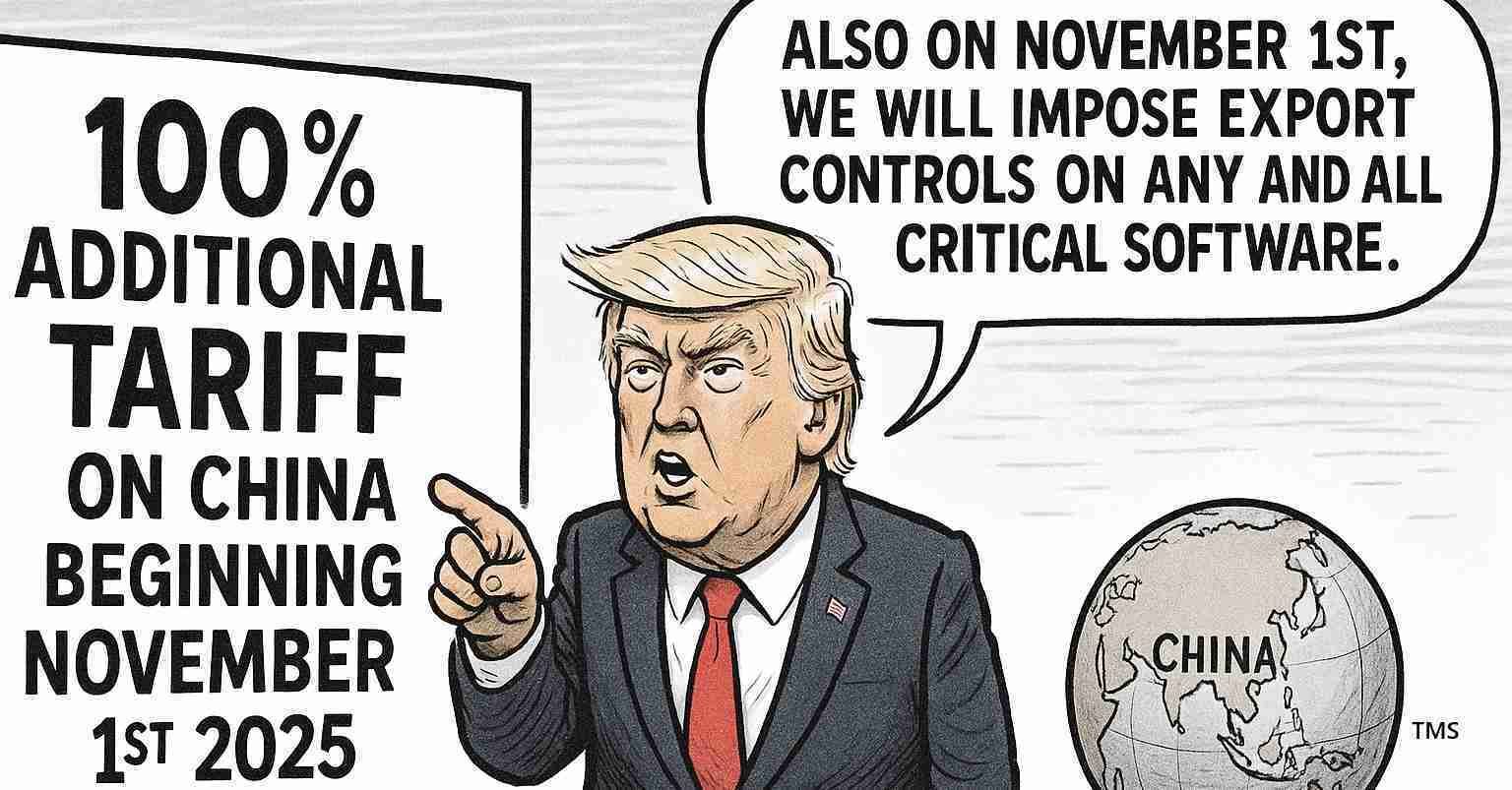
President Donald Trump announced an additional 100% tariff on all Chinese imports effective Nov. 1, 2025, citing Beijing’s expanded rare-earth export controls — a move that could accelerate a sharper U.S.-China trade confrontation and disrupt global supply chains.
- 100% surcharge: The levy will add 100% over and above existing duties on Chinese goods, effectively doubling tariffs on many products — reported by Fox Business and the Economic Times.
- Export controls on software: The administration also announced controls on “any and all critical software” to China starting the same date; specifics on scope and enforcement remain unspecified (Fox Business; Economic Times).
- Rare earths trigger: China expanded controls on rare-earth elements — adding five more elements and production technologies — which Washington cited as the immediate cause (Economic Times; CBS News).
What Trump announced and why
President Trump said the United States would impose a tariff of 100% “over and above any tariff that they are currently paying.” He named November 1, 2025, as the effective date but warned the levy could be implemented sooner if China takes further steps he called “aggressive.” The administration framed the policy as a direct response to Beijing’s tighter controls on rare-earth exports and the technologies used to process them (Fox Business; Economic Times).
Software export controls: Trump also announced new export restrictions targeting “any and all critical software” exported to China beginning the same date. Officials have not provided a definitive list of covered software or clarified licensing mechanics, leaving companies and supply-chain managers without clear guidance (Fox Business; Economic Times).
China’s rare earth export controls: the spark
Earlier this month Beijing added five elements — holmium, erbium, thulium, europium and ytterbium — to its controlled list and tightened restrictions on production technologies. That brings China’s controls to cover 12 of the 17 rare earths and expanded oversight of processing know‑how. Chinese officials say the measures are intended to prevent sensitive materials and technology from being used for military purposes (Economic Times; CBS News).
China dominates global supply of processed rare earths and magnets — in some markets supplying as much as 95% of magnets used in motors, sensors and defense systems. These materials are critical for smartphones, electric vehicle motors, jet engines and various weapons systems; disruptions could expose vulnerabilities in U.S. manufacturing and defense supply chains (CBS News; Economic Times).
Market, industry and diplomatic fallout
Financial markets reacted negatively after the announcement, with traders expressing concern that a new tariff round could slow global growth and compress corporate profits. Short-term market anxiety was visible in stock moves following the news (Fox Business).
Industry impact: Manufacturers reliant on Chinese components — from basic electronics to advanced subsystems — face higher input costs if the tariff takes effect. Firms may accelerate onshoring, diversify suppliers, or pass costs to consumers, but such transitions require time and investment and can produce short-term price increases (CBS News; Economic Times).
Diplomacy: Trump threatened to cancel a planned summit with Xi Jinping and denounced Beijing’s approach as “extremely aggressive,” saying the U.S. would act unilaterally if necessary. That posture increases the risk of reciprocal Chinese measures and an escalating trade confrontation (Fox Business; The Journal).
Uncertainties and possible next steps
Although Nov. 1, 2025, is the scheduled start date, the White House said the tariff could move sooner if China escalates. Key unknowns include the duration of the tariffs, potential carve-outs for critical products, and how export controls on software will be enforced. Negotiations, legal challenges, and reciprocal actions could change both timing and scope (Fox Business; Economic Times; Axios).
Why rare earths matter to Americans
Rare earth elements are relatively common in the earth’s crust but difficult to mine and refine economically. That concentration of processing capability has left U.S. tech, clean-energy and defense sectors dependent on imports of processed rare earths and magnets. Price spikes or supply interruptions could slow production of electric vehicles, smartphones and certain defense components. The push to scale domestic production and diversify suppliers is underway but requires significant time and capital (CBS News; Economic Times).
Implications for Redding, California
Economic impact: Redding and Shasta County are linked to national manufacturing, agriculture and energy markets. Higher tariffs could raise the cost of parts and equipment for local manufacturers and service firms that rely on imported electronics and machine components. Retail prices could climb if companies pass added costs to consumers, while some U.S.-based suppliers might gain business as firms reshuffle supply chains (Fox Business; CBS News).
Jobs and industry: Redding’s manufacturing, logistics and construction workforce could see mixed effects: some local suppliers may win new contracts from reshoring, while other businesses could face higher input costs that squeeze margins and hiring. Workforce and community colleges could play a role in retraining workers for reshored manufacturing roles (Economic Times; CBS News).
Energy and clean tech: Local clean-energy projects and households that rely on imported components (inverters, EV parts, magnets) could face higher prices if rare-earth limits tighten supply. Federal incentives or domestic investment could offset those effects over time, but short-term adoption of some technologies may slow (CBS News; Axios).
Political effects: The tariff announcement is expected to resonate with conservative voters who emphasize national security and domestic jobs. Local officials may press for federal investment in mining, processing and advanced manufacturing; the unilateral nature of the move may sharpen local debate over trade policy costs and benefits (Fox Business; The Journal).
Practical effects for residents
Consumers in Redding could face higher prices for electronics, appliances and other goods if tariffs are passed along. Local businesses that import parts should review contracts and consider alternative suppliers. Workers in logistics, manufacturing or at firms tied to national supply chains should watch for employer notices about sourcing changes, hiring adjustments, or retraining programs (Fox Business; CBS News).
What to watch next
Key items:
- Policy details on export controls for software and any carve-outs for critical goods.
- China’s immediate diplomatic and trade response, including possible retaliatory tariffs.
- Guidance from federal agencies and industry associations that will inform company compliance and supply-chain adjustments (Fox Business; Axios; CBS News).
Sources
Primary reporting and background drawn from: Fox Business; Economic Times; CBS News; The Journal; Axios.



