
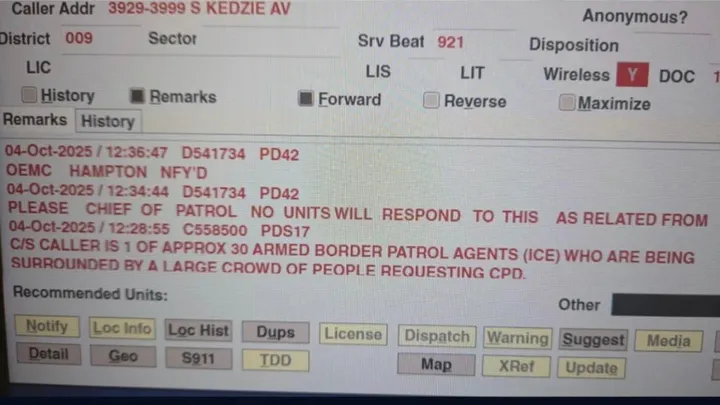
Chicago officers fault department after patrol chief allegedly orders “no assistance” as federal agents were rammed and surrounded
Chicago police sources say officers were ordered not to assist federal agents who became surrounded and their vehicles rammed during a violent protest, with internal dispatch audio and video prompting questions about interagency cooperation and accountability.
Key takeaways
- Chicago police non-assistance: Officers reportedly told not to intervene when federal agents requested help.
- Federal agents surrounded: Video and eyewitness accounts show vehicles boxed in and struck by crowds.
- Dispatch logs cited: internal dispatch recordings and audio have been posted publicly and cited in reporting.
- Political scrutiny: Critics demand answers from Mayor Brandon Johnson’s administration on policies affecting local-federal cooperation.
Main story
What happened: timeline from available records
According to publicly shared footage and audio, the confrontation began after a reported shooting involving authorities drew a large, hostile crowd. Federal agents moved into the area as tensions escalated; video captures moments when agents’ vehicles were boxed in by crowds and, at times, struck.
Multiple Chicago police sources told reporters uniformed officers were on nearby streets and received requests for assistance from federal personnel. Those sources say a patrol chief ordered officers not to intervene; the direction is audible in the internal dispatch audio that circulated online.
Dispatch records and officer accounts
Times Media Service reviewed layered radio traffic that appears to show a patrol sergeant or patrol chief instructing officers to maintain position and not assist federal personnel. In some recordings, officers on the ground react with concern as the situation intensifies.
Those files — described in reporting as internal dispatch recordings and public video — are reported by department sources and have not been officially confirmed in full by the Chicago Police Department.
Video and eyewitness accounts
Live video shows chaotic encounters between federal agents and protesters. Clips capture agents attempting to depart in vehicles while crowds press in; in several recordings vehicles near agents appear struck or defensively maneuvered as people closed in.
“Eyewitnesses filmed portions of the confrontation and in several clips can be heard calling for local police to step in to protect federal agents,” reporting states.
These videos circulated widely on social platforms and were cited alongside the dispatch audio used to corroborate claims that agents were surrounded and at risk.
Reactions inside the department and political fallout
Frustration grew within police ranks as sources said patrol-level personnel were told to stand down while federal colleagues faced immediate danger. Department insiders called for a transparent inquiry into why assistance was withheld and whether policies need revision.
Politically, critics demand clarity from Mayor Brandon Johnson’s office; some argue restrictive cooperation policies can erode public safety, while others cite community concerns about federal enforcement tactics as justification for careful limits on interagency action.
Questions for city leadership and accountability measures
- Who issued the order not to assist federal agents, and on what legal or tactical basis?
- Were any officers disciplined or reprimanded for following or failing to follow the patrol chief’s directive?
- Did withholding assistance violate interagency agreements or endanger federal personnel?
- Will the mayor’s office and CPD publish the full dispatch logs and a detailed timeline?
Safety, enforcement and community trust
Community members and protest leaders have argued federal agents escalated tensions in the neighborhood — part of a broader debate about federal presence in local protests. Still, police sources emphasize clear, consistent protocols are necessary when multiple agencies operate on the same streets.
Concern: If patrol commanders receive standing orders not to assist federal colleagues even in dangerous situations, cooperation and mutual aid could suffer long-term effects, slowing responses and putting officers and civilians at risk.
Implications for Redding, California
- Economic impact: Breakdowns in interagency coordination can increase overtime, security costs and potential liabilities — a caution for Redding’s municipal and county budget planners.
- Political consequences: Conservative readers in Redding may use Chicago as an example in local debates to push for clearer mutual-aid agreements and stronger support for officers.
- Social effects: Public trust can erode when responders are perceived as unwilling or unable to protect fellow officers; local groups may press for transparency on multi-jurisdiction responses.
- Practical applications: Emergency managers should review mutual-aid agreements, dispatch protocols and joint training to reduce confusion during protests and mixed-jurisdiction incidents.
Source material
Reporting in this article draws on internal dispatch audio, eyewitness video and accounts reviewed by Times Media Service and posted publicly. At the time of publication, city and police officials had not released a full, public timeline or a detailed explanation of the orders referenced in the recordings.
Investigations and potential developments
Times Media Service will continue to seek official records, full dispatch logs, and formal statements from the Chicago Police Department, the mayor’s office and federal agencies involved. Department sources are urging a transparent inquiry to determine the chain of command and the rationale behind the decision that, according to available recordings, limited assistance to federal agents during the confrontation.
Note: The account in this article is based on department sources, public video and audio recordings; official confirmations and additional records remain pending.


